

Buying a car
What counts as high mileage on a used car
A mileage only means something next to the car’s age. We took the odometer readings from more than 5.5 million MOTs to show what is typical for a car of each year. A big number tells you less than you might think.
By Tania Elsafin. Updated
What counts as high mileage for a used car?
It depends on the car’s age. By our count of DVSA records, the typical car covers about 5,800 miles a year. At their MOT in early 2025, half of all 2015 cars had done more than 72,200 miles and one in ten more than 124,900. High means more miles than three in four cars of the same year.
Typical mileage by year of registration
These are the odometer readings at MOTs in February and March 2025, by the year each car was first registered. Half the cars of each year had done more than the middle reading.
A car you see today has been driven since. For a car used the typical amount, add about 500 miles for each month since March 2025.
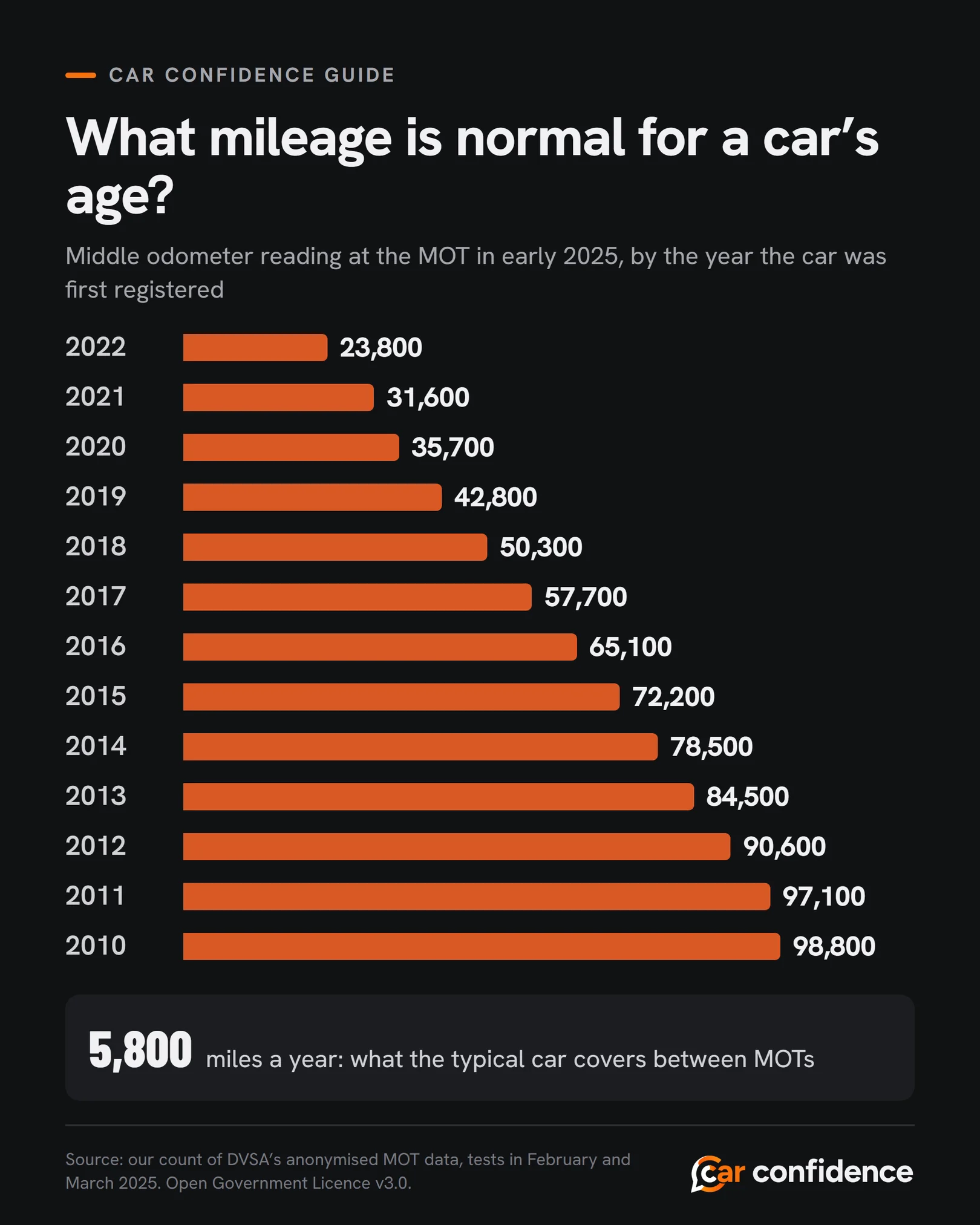
| First registered | Middle reading | Three in four had done less than | Nine in ten had done less than |
|---|---|---|---|
| 2022 | 23,800 | 34,400 | 49,100 |
| 2021 | 31,600 | 44,700 | 61,400 |
| 2020 | 35,700 | 49,500 | 67,300 |
| 2019 | 42,800 | 58,400 | 78,600 |
| 2018 | 50,300 | 67,600 | 89,500 |
| 2017 | 57,700 | 77,300 | 101,600 |
| 2016 | 65,100 | 86,800 | 113,600 |
| 2015 | 72,200 | 96,200 | 124,900 |
| 2014 | 78,500 | 104,100 | 133,000 |
| 2013 | 84,500 | 111,200 | 139,900 |
| 2012 | 90,600 | 118,900 | 148,300 |
| 2011 | 97,100 | 126,500 | 156,700 |
| 2010 | 98,800 | 128,600 | 159,000 |
Cars cover fewer miles as they age. In our count three-year-old cars did about 7,400 miles a year between tests and fifteen-year-old cars about 4,400.
Diesel, petrol, hybrid or electric
Fuel makes a difference too. These are the miles each car covered between one MOT and the next, from the same car’s two readings.
| Fuel | Typical miles a year | Cars counted |
|---|---|---|
| Electric | 7,900 | 20,388 |
| Hybrid | 7,600 | 78,864 |
| Diesel | 7,000 | 668,652 |
| Petrol | 4,900 | 957,721 |
So the same reading is more unusual on a petrol car than on a diesel. Most electric cars on the road are still young. Young cars cover more miles.
When high mileage is fine
- The mileage climbs evenly from test to test. A car used regularly avoids the problems of one left standing, such as flat-spotted tyres and seized brakes.
- The service record keeps pace with it. Services at the intervals the maker sets say more than the total.
- The MOT history is quiet for the age: wear items, few repeats and nothing on brake pipes, steering or the structure.
- The wear inside matches the reading. Worn pedals, a shiny steering wheel and a sagging seat on a low-mileage car are a question.
When low mileage needs a question
A very low reading for the year can mean a car that sat unused, was declared off the road or had its odometer wound back. In our count about 1 car in 650 showed a lower reading at its next MOT than at the one before.
Low mileage on its own isn’t a fault. Ask why the car was used so little and look for gaps between MOTs.
How to check the mileage on a car you might buy
- Read the mileage at every MOT in the car’s history. Each should be higher than the last.
- Work out the miles a year between tests and set them against the tables above.
- Match the latest MOT reading with the odometer and the advert, allowing for the months since the test.
- Ask for the service history and check that its mileages fit the MOT readings.
- If the reading is high, look harder at the parts that wear with miles: tyres, brakes, suspension and the clutch.
How we counted
The readings are DVSA’s, from the anonymised MOT data it published in June 2026. The mileage table draws on 5,578,183 normal MOTs in February and March 2025 on cars and light vans (MOT class 4) three to twenty years old. A car’s year is the year it was first registered.
The miles a year come from 1,729,171 vehicles we followed from an MOT in March 2024 to their next one in February or March 2025, using the two readings on the same car. Readings of zero were left out.
Contains public sector information licensed under the Open Government Licence v3.0.
FAQ
Questions people ask
What is the average mileage per year in the UK?
By our count of DVSA MOT records, the typical car covers about 5,800 miles between one MOT and the next. The average is higher, at about 7,000, because a few cars do very high mileages.
Is 100,000 miles too many for a used car?
Not by itself. In our count one 2015 car in four had done more than 96,200 miles by early 2025. The service record and the MOT history tell you more than the odometer.
Is low mileage always better?
No. A car that barely moved for years can need work on its tyres, brakes and battery. Check the MOT history for gaps.
How many miles a year is a lot?
In our count one car in four covered more than 9,100 miles between MOTs. Above that, a car is doing more than most.
Do electric cars do more miles?
In our count the typical electric car covered 7,900 miles between MOTs against 4,900 for a petrol car. Most electric cars on the road are still young. Young cars cover more miles.
The checks in this guide
More guides
Free car check
Check it before you go and see it
DVLA details, tax and MOT status, mileage and the full MOT history, free for any UK registration.